
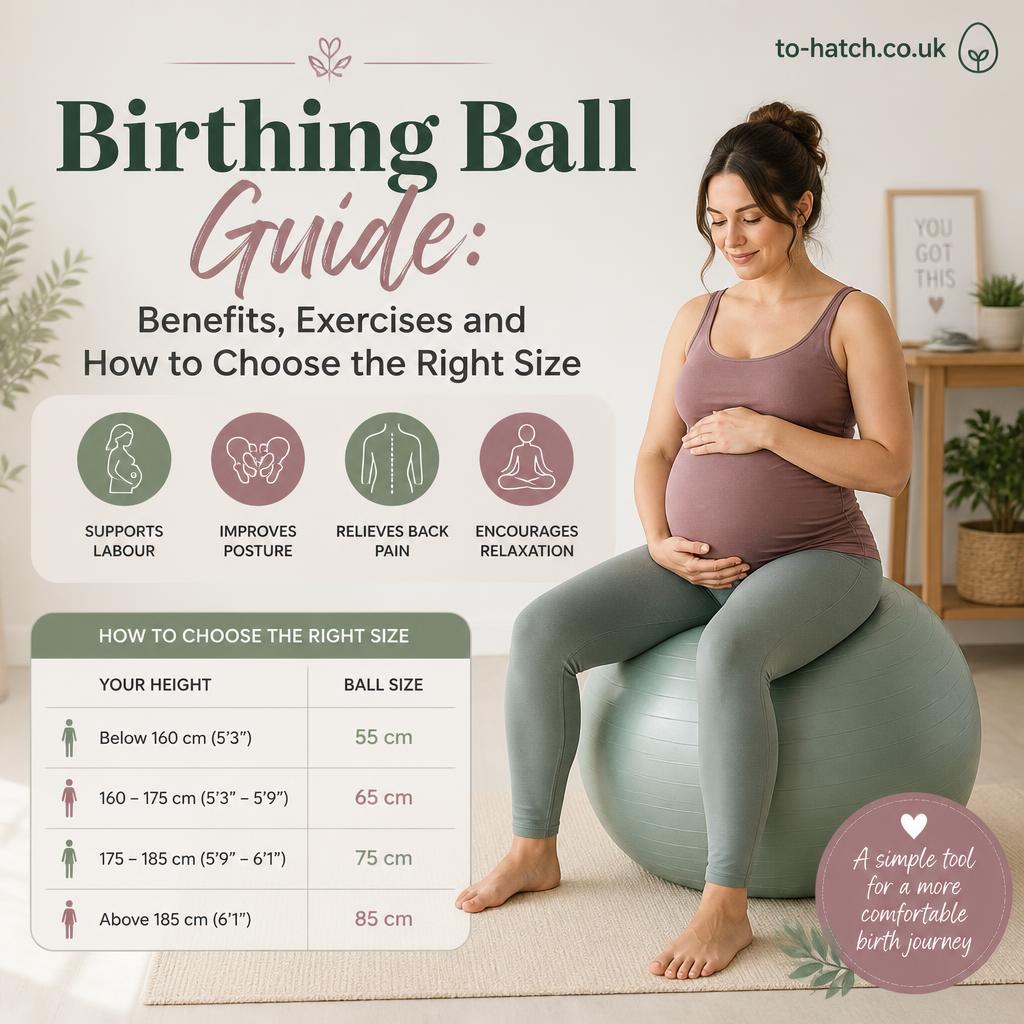
A birthing ball is one of the simplest, cheapest tools for easing pregnancy discomfort and helping labour progress — and you don’t need a class or instructor to start using one. Here’s how it actually helps, and which exercises are worth trying.
What Is a Birthing Ball?
A birthing ball (also called a pregnancy ball or exercise ball) is a large inflatable ball, typically 55–75cm depending on your height, used to support gentle movement and positioning through pregnancy and labour. It’s essentially the same as a standard gym exercise ball, though some are specifically marketed as “birthing balls” with reinforced anti-burst material for added stability.
Benefits During Pregnancy
- Eases lower back pain by encouraging better posture and taking pressure off the spine compared to sitting in a regular chair.
- Opens the pelvis through gentle hip circles and rocking movements, which some believe can help encourage optimal positioning of the baby, though evidence for this specific claim is limited.
- Strengthens core and pelvic floor muscles gently, without high-impact strain.
- Improves circulation in the legs compared to prolonged sitting, which can help reduce swelling.
Using a Birthing Ball in Labour
Many maternity units have birthing balls available, and midwives often encourage using one during early labour to help manage contractions through movement and gravity, rather than lying still in bed. Sitting and gently rocking or circling the hips on the ball can also help take pressure off the lower back during contractions, and upright positions supported by the ball may help labour progress compared to lying flat.
Simple Birthing Ball Exercises
- Pelvic tilts — sit on the ball with feet flat, gently rock your pelvis forward and back.
- Hip circles — sit and slowly circle your hips clockwise, then counterclockwise, to ease tension in the lower back and pelvis.
- Figure-eights — trace a figure-eight motion with your hips while seated, a common technique used in active labour.
- Bouncing — small, gentle bounces while seated can help ease discomfort and encourage the baby to engage lower into the pelvis in late pregnancy.
Choosing the Right Size
When seated on the ball, your knees should sit slightly below your hip level, roughly at a 90-degree angle or a little more. As a general guide, a 55cm ball suits people up to about 5’4″, 65cm suits average height, and 75cm suits people over 5’10” — though checking the manufacturer’s height chart for the specific ball is more reliable than relying on general rules.
Safety Tips
- Use the ball on a non-slip surface, ideally on carpet rather than a hard, slippery floor.
- Make sure it’s fully inflated — an underinflated ball is less stable and more likely to shift unexpectedly.
- Have something sturdy nearby to hold onto when getting on or off, especially later in pregnancy as balance shifts.
- Stop if you feel dizzy, and avoid using the ball if you’ve been advised to limit physical activity for any pregnancy-related reason.
FAQs
When should I start using a birthing ball?
You can start using one at any point in pregnancy, though many people find it most useful from the second trimester onward as back pain and pelvic discomfort increase.
Can a birthing ball help induce labour?
There’s no strong evidence it can start labour on its own, but movement on the ball may help labour progress once it’s already begun, largely by encouraging helpful positioning and easing tension.
Is it safe to use a birthing ball at home without supervision?
Yes, for general pregnancy comfort and gentle exercises — just make sure it’s properly inflated, used on a non-slip surface, and that you have support nearby if needed.
